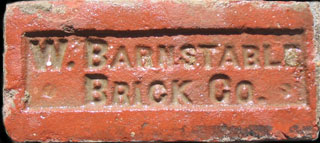
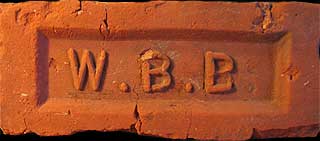
|
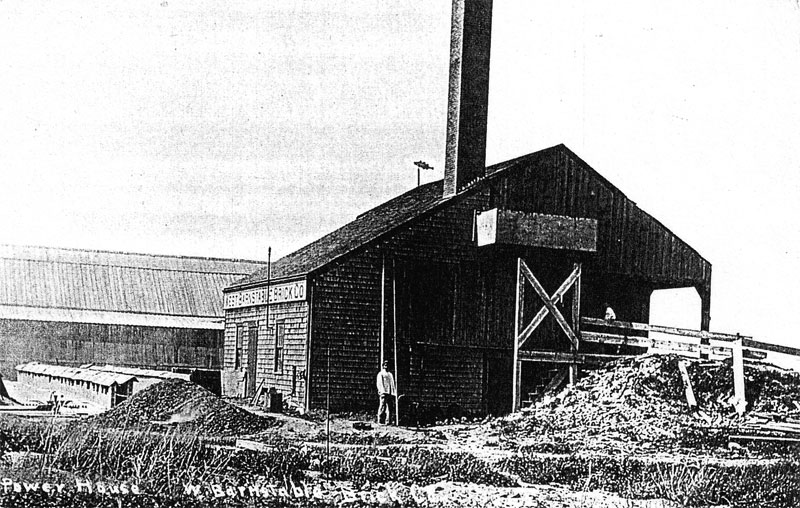
In 1887, Abel D. Makepeace (known as the "cranberry king") joined the brick company as treasurer, then became a principal owner until 1925 when Thomas Arden took over. Abel also owned the Old Village store as well as a stable and the village's first automoblie, a Stanley Steamer. He used Barnstable Bricks to build sorting sheds for his cranberry business.
Tragedy struck in 1907 when one of the workers, Elias Kaihlainem, was killed in the collapse of a bank of clay that was being undercut. A few years later, an executive of the company on his way to work was struck and killed by a train near the plant.
About 1932 a test hole was drilled to find out how much clay was left. "It was estimated that there was enough to last about fifty years, but an artesian well developed from the test hole and flooded all the clay pits and the company, not having funds to recover, went out of business." (From A History of the West Barnstable Brick Company, by D. G. Trayser, Feb 7, 1973.)
In Cape Cod Voyage Jim Coogan and Jack Sheedy relate another cause for the demise of W.B. Brick.
In 1928 President Hoover signed into law a national standard for brick. W.B. Brick Company found itself stuck with equipment that made bricks that were one eighth of an inch too short. They were forced to buy new equipment to meet the national standard and, to cover its costs, raised its brick prices just as the country
was headed for the Great Depression. In 1933, the First National Bank of Yarmouth called in a $30,000 loan and the W.B. Brick was forced into bankruptcy, never to recover.
The equipment was eventually purchased by Stiles & Hart in Bridgewater, MA
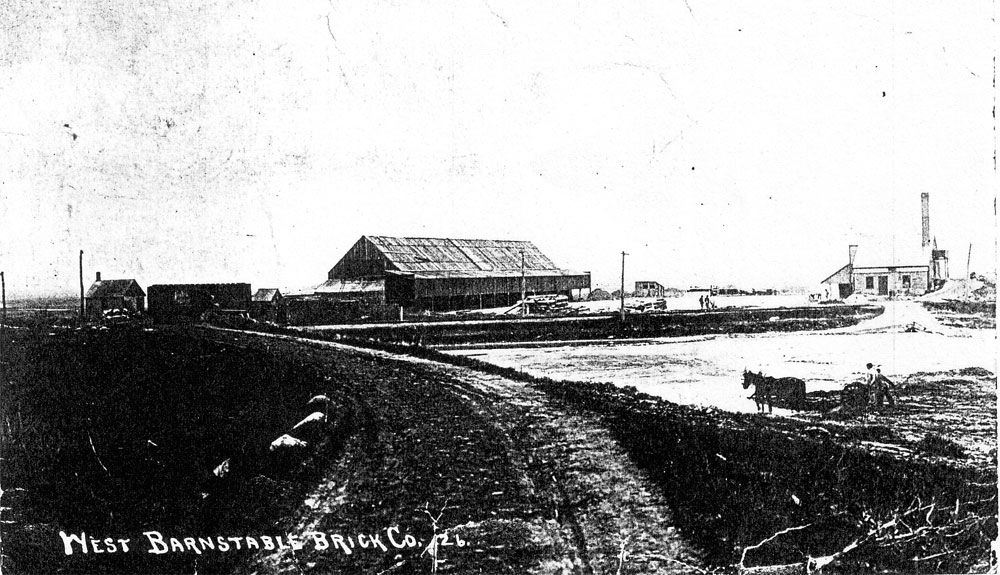
(B&W photos courtesy Whelden Memorial Library, W. Barnstable, MA)
==========
"The West Barnstable Brick Company has recently installed a new pumping outfit. It has a ten-inch suction pipe. The motor power is furnished by the Fordson tractor presented to the company's owner Thomas Arden by Henry Ford. The company has orders for brick which will carry them until late in the season." (From the "Barnstable Patriot" archives, 1928)
==========
1908
1915
1920
1932
1949
2008
In December 2008, members of the Barnstable Community Preservation Committee toured the property.
An article in the Barnstable Patriot reads:
"Now the broad cart paths, down which donkeys carried clay from pits to the factory building, are used by the Pogorelc family to walk to scenic outlooks and observe wildlife. They, too, have made their mark on the land; and like their predecessors have decided it's time to move on.
'We have reached a time in our life when we need to relax and plan our next 25 years,' Bob and Barbara Pogorelc wrote in a fact sheet prepared for the CPC's visit. 'We feel that this property should be in public hands to preserve the natural beauty and history.'"
2013
2015
==========
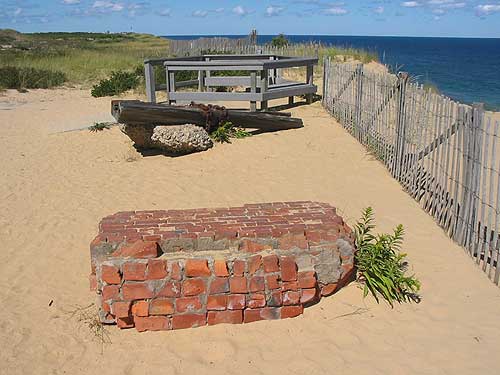
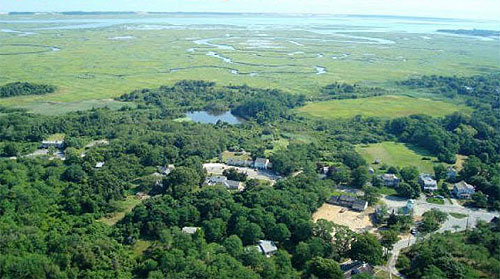
Orenda Wildlife Land Trust has acquired a portion of land once occupied by the historic West Barnstable Brick Company. A 6.97-acre conservation restriction held by BLT now permanently protects the site. “There are wonderful views of the Great Marsh,” Liz Lewis noted, “with some decent wooded paths for walking.” The trails were former cart paths that led to the brick factory.
The West Barnstable Brick Company was founded in 1887 and operated until 1933, making millions of bricks a year in its heyday. The 17-acre property once spanned Old King’s Highway, crossed the railroad tracks and abutted the Great Marsh along Brickyard Creek. Around 1932 a test hole was drilled to determine
how much clay remained. According to "A History of the West Barnstable Brick Company" by D. G. Trayser, “It was estimated that there was enough to last about fifty years, but an artesian well developed from the test hole and flooded all the clay pits.”
About the same time, a new national standard for brick size was adopted. West Barnstable bricks were an eighth of an inch shorter than the new standard, forcing the company to buy all new equipment. To cover costs, it raised its brick prices…just as the country was plunging into the Great Depression.
The First National Bank of Yarmouth called in a $30,000 loan, forcing the company into bankruptcy.
The land protected by Barnstable Land Trust and Orenda now provides a critical buffer to a freshwater pond fed by groundwater. The property, identified
as priority habitat for rare species, is part of a critical natural landscape area. The parcel also lies within the 9000-acre Sandy Neck/Barnstable Harbor Area of Critical Environmental Concern (ACEC) and connects to Town and BLT conservation land in the Great Marsh.
Orenda Wildlife Land Trust, Inc., a private nonprofit land trust, preserves open space for wildlife habitat on Cape Cod and throughout Massachusetts. Orenda
takes its name from a Seneca Indian word meaning “protected place” and was inspired by the Orenda Song of Praise,” which honors our connection to nature and
the earth. The song begins with “Every seed that sends down roots and puts out leaves to greet the sun honors its Orenda.”
==========
==========
Makepeace early recognized the value of the Finn as a worker. On one occasion, it is reported, he observed three men struggling frantically to move a tree stump, when two Finns happened along and, seeing the vain efforts, waved the workers aside and walked off with the stump. Although the story savors of exaggeration, in principle it may be accepted at face value. However that may be, Mr. Makepeace had to go to Boston from time to time to get new workmen for his growing business. Whenever he could induce a few Finns to return to the cape with him he did so. Other Finns, exhibiting the clannish propensities of their group, filtered into this region slowly as they learned of the presence of fellow-countrymen and the chance to earn a living.
The first permanent group settlement seems to have been made at West Barnstable, where the largest group resides today (ed. note: this was written in 1933). One of the first settlers in this group, Emil Lundquist, from Ustad, near Turku (Abo), Finland, still survives. His father, who came over two years before him, is said to have been the first Finn in the village. His name implies Swedish blood, but his mother was a Finn. Lundquist reached West Barnstable forty-three years ago and first worked on the railroad. Then he shifted to a brick plant in West Barnstable - the only one on the cape, and a haven for Finns for many years. The sequence of jobs is typical of the Finns who did not go to the bogs at once. Many of those who first toiled at railroads or brick-making, eventually cultivated cranberries.
Published in New England Quarterly VI, p. 597-601. 1933.
==========
According to Names of the Land" by Eugene Green, "From the early 1700s, there was a kiln near the road to fire clay into bricks. Josiah Thompson, the last to make bricks, had his kiln in the 1800s on Forest Hill just off the road."
From Yucatan Adventure.com we learn that:
Josiah Thompson built one of the first vacation cottages on Cape Cod. He was in the brick trade and later moved the family's summer residence to West Falmouth, lured by the rich clay deposits he found there.
He built a brick kiln and a lofty house.
As a side note, his son, Edward Herbert Thompson is responsible
for lure of Chichen Itza, the restored city of the ancient Maya, as a tourist attaction.
Clarence J. Anderson, a now deceased local historian for Falmouth wrote about the first Europeans to arrive on the Cape. They "had no brick to build their chimneys. For their first log cabins they built chimneys and fireplaces of stone and plastered them with lime made from crushed clam shells. In a few years (they) quickly learned that local timber had much value in their homeland of England, so they started shipping timber there. The ships had to be ballasted in the empty hold with stone when coming back. They soon found they could ballast their ships with English brick. In this way they were paid both ways as stone would only be thrown overboard when they got back here. This created a good trade as brick was needed for chimneys here.
Falmouth's English settlers also began making bricks at the clay pits on Brick Kiln Road on what is now know as the Thompson property. This continued for several years but the brick from there was of very poor quality--it was bright red in color, very soft and powdery and it could not stand the weather above the roof line.
There are some houses in Falmouth today that contain Brick Kiln Road brick but most are gone. Ballast brick can still be found all over Falmouth in chimney foundations and cellars. Ballast brick is still as good as when it was made some 300 years ago.
The English imported brick was known by two names--1) wheatstraw, or 2) ballast brick. In shipping it here, layers of wheat straw were layed between layers of brick to keep them from breaking up when the ships pitched in rough weather. The size of English brick was determined from time to time by the King of England. During the time ballast brick was being brought over here, the size was 7 inches by 3 3/4 inches and 1 3/4 inches.
Brick Kiln Road brick died out early, as better quality brick was being made in West Barnstable, which became the key source for people here. Later, brickmaking ceased on Cape Cod as good bricks were made in New York and Pennslyvania."
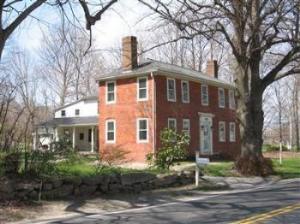
In 1815 a brick house was built at 100 Tupper Road and to this day is the only brick house in Sandwich. It is said to have been built by Simeon Leonard, then the owner of the Town Neck brickyard.
Lovell writes: "In 1819 the town appointed an officer whose title was 'Surveyor of Brick.'" Although there was only one brick house, the yard provided foundation materials for many Federal period buildings throughout the town.
The first deed referring to the brick kiln so far known is dated 1828 when the owners were David Benson and Simeon Leonard. The property was two acres bounded by the shore to the east, private land at the marsh, and by the proprietors' lands.
The next owner of the brickyard was Cyrus Smith who, in 1829, sold it to Deming Jarves, founder of the the Boston and Sandwich Glass Company (located in "Jarvesville"). Jarves used the Town Neck yard to produce brick for the numerous factory buildings located just across the marsh from the kiln. According to Lovell (p. 331), there was a narrow but solid bridge running from Town Neck across the marsh to Jarvesville near State Street. "This bridge was especially for use of a narrow one-horse wagon which brought bricks from the kiln over to Jarvesville."
Deming Jarves was the main principal of the glass company until 1858, when he resigned over a dispute with its Board of Directors. Deming and his son, John, began another glass company just down the street called the Cape Cod Glass Works. At least 500,000 bricks needed to construct the buildings and chimneys of this new factory mere made at the Town Neck yard.
When the "Pot Room" of the Boston and Sandwich Glass Factory was torn down in 1937, its bricks were used as facing for a new building being constructed on Main Street in Hyannis for the Cape Cod Standard Times (today’s Cape Cod Times).
In the Sandwich Town Archives is a copy of the deed for Jarves’ purchase of the Brick Yard, dated October 3, 1829:
"I, Cyrus Smith of Sandwich in the County of Barnstable, State Massachusetts in consideration of seventy dollars paid by Deming Jarves of Boston in the County of Suffolk the receipt whereof I do hereby acknowledge, do hereby give, grant, sell and convey unto the said Deming Jarves an undivided half of a certain piece of land own'd in common with said Jarves & is bounded as follows. North by the Sea shore, East by the lands of John Dillingham and the heirs of John Dillingham deceased, South & West by Town Neck so call'd and is known by the name of the Brick Yard & is so occupied, containing two acres more or less and is the lot which I purchased jointly with said Jarves, one half of David Benson Oct. 6, 1828 & is recorded in Barnstable records Oct. 7, 1828, 3o Book folio 123, the other half of Wm Fessenden Dec 8, 1828 & is recorded July 15, 1829. 2o Book folio 121 -- the said lot to be held subject to the order of the Attorney appointed by said Smith agreeable to an indenture made and executed the 3 day, October 1829. ...
In Witness Whereof, I the said Cyrus Smith and Lucy, wife of said Cyrus in relinquishment of her right of Dower have hereunto set Hand & Seal on this ninth day of October in the year of our LORD, One thousand eight hundred and twenty nine."
SOURCES CONSULTED:
Webmaster Note:
Other sources:
Hudson River Brickmaking |
Brick History/How Bricks Were Made
|