|
A BRIEF HISTORY of CROTON-ON-HUDSONfrom the perspective ofthe Great Hudson River Brick Industry at Croton Landing and Croton Point.
Sarah Gibbs Underhill, Kerhonkson, NY
The first time I came to a Clearwater Revival (an annual music fest sponsored by Hudson River Sloop Clearwater) in 1985 my eye was caught by the “Underhill Ave.” exit sign where I was to turn off for Croton Point. This was my first inkling that the sense of homecoming I felt at Croton had roots that went back further than my connection with Clearwater. The better I get to know the Point, the more I appreciate its unique natural and human history. Croton Point has many stories to tell, and one of them – an ongoing one – is ours. Located in the lower Hudson Valley on the river’s eastern short, Croton Point (earlier names for it were Senasqua, Teller’s Point, and Sarah’s Point) has been owned by Westchester County since 1924. Happily, it is no longer being used as a county landfill and all traces of that unfortunate land use are now cleaned up. The Croton Park we know today is an idyllic and beautiful spot surrounded on three sides by the river’s bays where Hudson Valley residents can enjoy the natural surroundings. Our family history of the Point begins 200 years ago. In 1804 Croton Point was purchased by a Quaker gentleman named Robert Underhill (my great-great-great-great- grandfather, but who’s counting). Along with his brothers Joshua and Abraham, he operated a grist mill on the Croton River and he began to cultivate vineyards on the southern slopes of the point. His 250 fertile acres yielded crops of watermelons, apples and grapes for the New York City market. During the War of 1812, when shipments from southern states were under attack, old Mr. Underhill shrewdly planted huge fields of watermelons and had a fleet of cargo sloops (the Hudson River Sloop “Clearwater” is a replica of these) waiting off the point for the crop to ripen. The melons were in great demand in New York City at this time, and could get there without harassment from the British Navy.
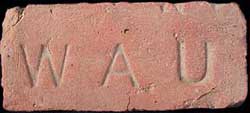
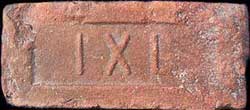
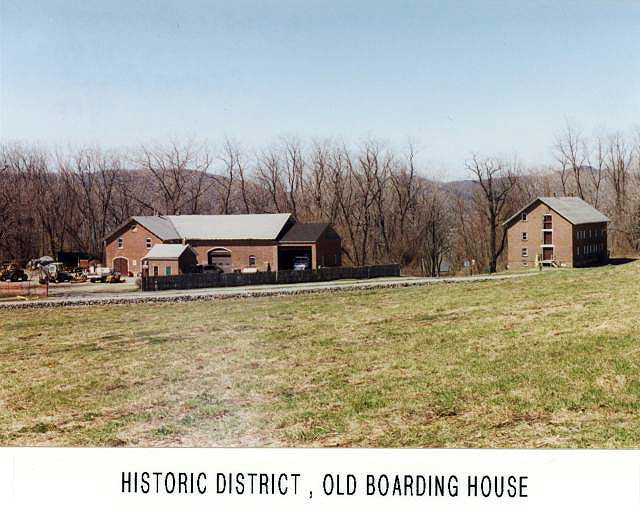
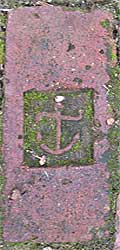
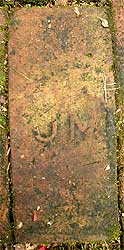
William A. Underhill Brickyard, Croton Point, NY His sons Richard and William inherited the property, dividing it between them. William concentrated on developing a brick industry around which grew the Village of Croton Point. Bricks with his initials, “W. A. U.”, and others with the very un-Quakerly self-promoting cryptogram “IXL” (not a proper roman numeral, but rather a claim that he “excelled” at making bricks) may still be found on the beaches at low tide. These were used to build the brick barns which still stand, a three-story barn for fruit and a large carriage and horse barn as well as a brick schoolhouse for the children of the employees of the brickyard and the farm.
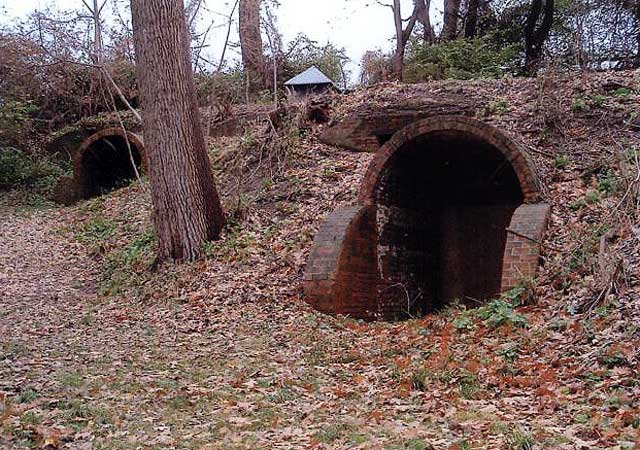
Two vaulted brick wine cellars, still in excellent condition, were built into the hillside to store wines from the extensive vineyards. There is a growing interest in the community in having these brick buildings restored and researched as an historical archaeological site. A 21st scentury use for the wine cellars which I considered while camping in the park on a crowded weekend would be as fallout shelters in the event of a terrorist attack on the nearby Indian Point nuclear power plant. Rather than get stuck in gridlock traffic, I told my kids we should all meet in the wine cellars thoughtfully provided for us by our family. Fortunately, we did not have to do this. Dr. Richard T. Underhill, b. 1802, the vintner and proprietor of the southern part of Croton Point, had discontinued his medical practice in New York City to take up residence out on the tip of the Point. He built an Italianate villa there in 1846 as his residence which he christened “Interwasser”. In 1850 four English yew trees were planted in front of this home and I can imagine his brother William, of the IXL word-play, having a lot of fun with the term “U’s yews”.
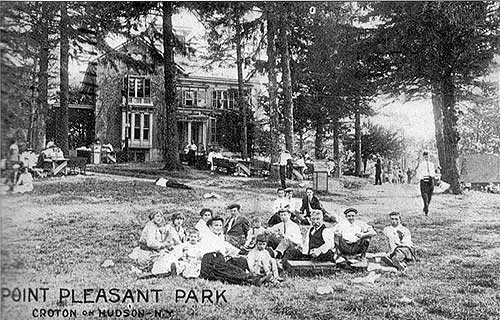
Picnicing on the Lawn at Interwasser, Croton Point, NY Today few traces of the house remain; only a few Ashlar marble foundation stones peeking out of the ground, and an old stone hitching post. I pitch my tent on this site during the Clearwater festival and enjoy the site inhabited by my forebears. Cooled by river breezes and with wonderful views of the Hudson (more so in the winter when the leaves are off the trees), it is still a spectacular spot. The four yew trees are still standing, and have grown to heights of 60 to 100 feet. Since this species can live to be up to 1,000 years old, I have undertaken the task of tending to their health (see press release below). An unpublished but formally written historical account left by an Underhill descendant in the Westchester County Historical Society collection describes “Interwasser” thus: “Ashlar marble quarried at (nearby) Sing-Sing and cut by prison labor formed the basement while the upper portion was stuccoed brick. Over the front door was a tower room enjoying extensive views up and down the river. It was another large and commodious house given to hospitality and one of the show pieces in the county. Visitors from far and near were attracted to the Point houses, as traditions and letters bear ample testimony. Among the many assets of the place were shad fishing and crabbing, duck shooting and hunting, boating and skating, together with the wonderful gardens and orchards and all permeated with the most cordial atmosphere.”
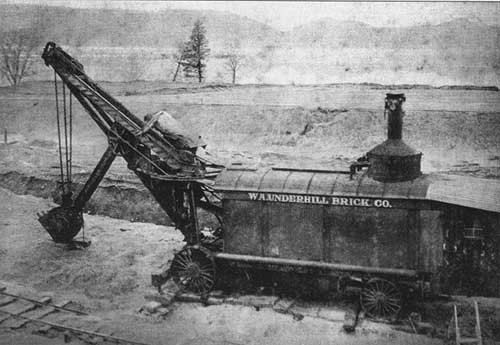
Steamshovel at William A. Underhill Brickyard, Croton Point, NY Another account (possibly by the same author, James Wood, b. 1870, as narrated to his grandson Jim Wood of Braewold, Mt. Kisco) describes “My Brothers and Sisters’: “Abby… married William A. Underhill of Croton Point. He was a son of Robert Underhill, son of Isaac and brother of Caleb, and therefore a first cousin of Mother. His brother… Richard T… was a New York City doctor and afterward owned the “End of the Point”, and never married… William A. inherited [under what terms I never knew] the Point homestead. He was successful in the brick business and with the vineyard of Catawba and Isabella grapes… Dr. Underhill had vineyards also, but never brickyards. Both vineyards and brickyards were profitable. Having an ample income they dispensed a most generous hospitality. The house was generally filled with guests who always admired and loved their hosts. Abby was queenly, and William A. very lovable. Their children were Elizabeth, Stephen, Mary and Phoebe. Elizabeth never married and became quite hard of hearing She was a pleasant conversationalist. She it was who said, “The Psalmist said, ‘While I mused, the fire burned’, but while I mused, the fire went out!” It was the delight of my boyhood to spend considerable time at Croton Point.” Bricks from the Underhill Brickyard were also used in 1855 to construct “Surwood” (later called “Evergreen”), a home of the John J. Wood family in the Mt. Kisco complex known as the “Woodpile”. This home was designed on the same lines as “Interwasser” and still stands and is occupied today. WEBMASTER NOTE: Sarah Underhill has spearheaded a special campaign to save the 4 yew trees at the "Interwasser" site. Anyone interested in contributing to this effort can contact The U’s Yews Project, c/o Underhill, 1150 Berme Rd., Kerhonkson, NY 12446
Marian F. Graves (1957)
In 1804 the whole area (of Croton Point) consisting of some 250 acres was purchased by Robert Underhill, owner of the flour mills along the Croton River. The land was fertile and Mr. Underhill became a prosperous farmer. The story is told that during the war of 1812, he planted eighty acres of watermelon in order to supply the New York market which had been cut off from its normal supply in the south because of the British patrol. Another successful undertaking was the raising of castor beans. It is also said that at one time the growth of mulberry trees was encouraged with the idea of promoting silk wormculture. After the death of Robert Underhill, his two sons, Dr. Richard and William A. Underhill, divided the property and each developed a successful business. Croton Point Wine Dr. Richard, although trained as a doctor of medicine, gave up practice in New York to devote his time to agricultural pursuits. He became known as one of the leading agriculturalists of the country, and the producer of the famous Croton Point wine. In 1865, the Times described Croton Point wine as "decidedly the best and safest beverage that ladies can offer their callers on New Year's Day."
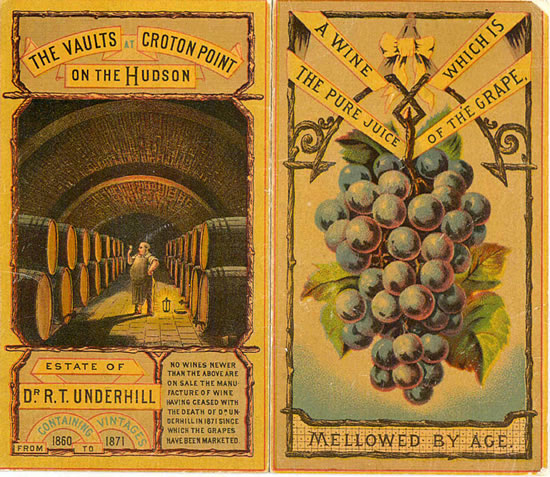
Underhill Wine Vaults, Croton Point, NY Dr. Underhill carried on numerous agricultural experiments and at one point developed a yellowish green grape which came to be known as the Croton Grape. In spite of the high quality of the fruit and its valued flavor for wine it did not become a popular grape because the vine was difficult to grow except in a certain type of sandy soil. The fruit was first exhibited by Stephen Underhill, nephew of Dr. Richard, in 1868. The Brick Yards William A. Underhill confined his energies to the northern section of the Point where a village grew up around his brick yards. The brick yards started about 1830 and were among the thirty-four brick yards along the Hudson in the Town of Cortlandt in the eighteenth century. Joining him in his business was his brother-in-law, Richard Talcott, a machinist and later his son-in-law and Richard Walker who assumed responsibility for the transportation of the bricks. (Ed Note: Scroll down for more information on Richard Talcott.) Advertising for the bricks stressed "their fine edge and durable qualities" and "extra large brick for the Cube Trade - hard, smooth and strong - produced in the steam brick works at Croton Point on the Hudson." Many of the bricks were marked with the makers initials W.A.U.
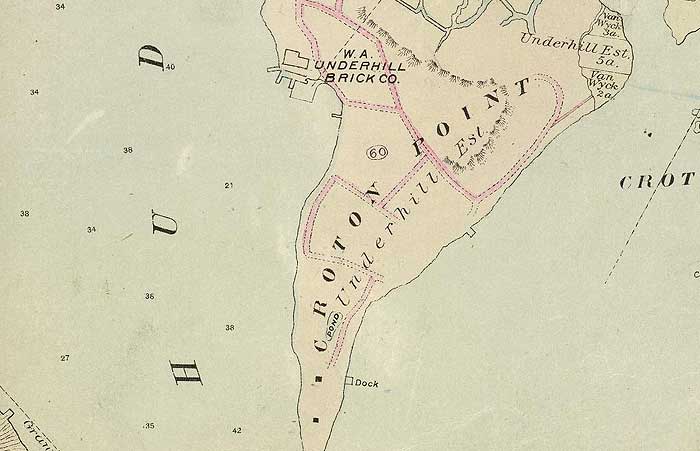
F.W. Beers map showing the location of the William A. Underhill Brick Company on Croton Point The Village In the days when there was a village at Croton Point, access to the Point was over the hill along the north side of the Point. The bridge over the railroad was known to local residents as the Kissing Bridge. Most of the people living on the Point were associated with the brick industry; there was a store, a school, tavern, boarding house and other facilities for a small village. Maps of the area in 1880 show the existence of several streets, mostly in the area of the present parking lot.
On this 1931 Map, some traces of the village remain About 1900 the Underhill holdings on Croton Point passed into other hands. The supply of clay was exhausted. The Village no longer prospered. During World War I it appeared that the Point would become the site of enormous factories. Fortunately, it finally became the property of Westchester County and its development as a public recreation area began in 1924.
Boarding House and store, one-room school house and 3-story brick barn remain today at Croton Point, NY
A village grew up around the brickyards. There was a store, a school, tavern, and other facilities for a small village. Most of the streets were in the area of the present-day parking lot.
The buildings pictured are used today for maintenance facitities at Croton Point Park.
Remains of Underhill Wine Cellars, Croton Point, NY
Croton Brickyard Owners & Operators: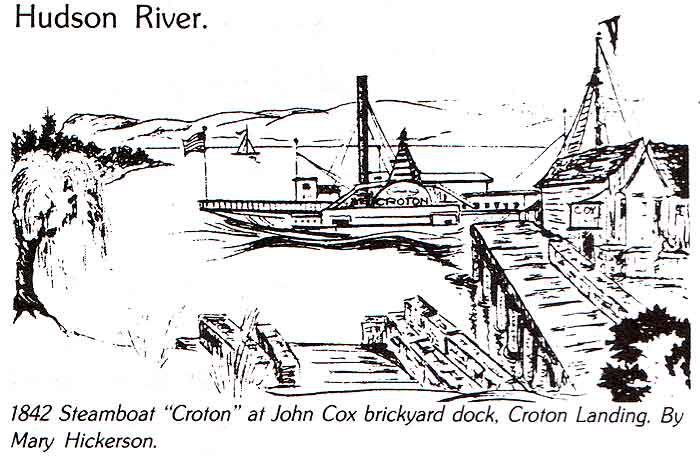
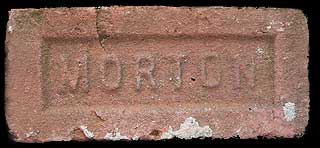
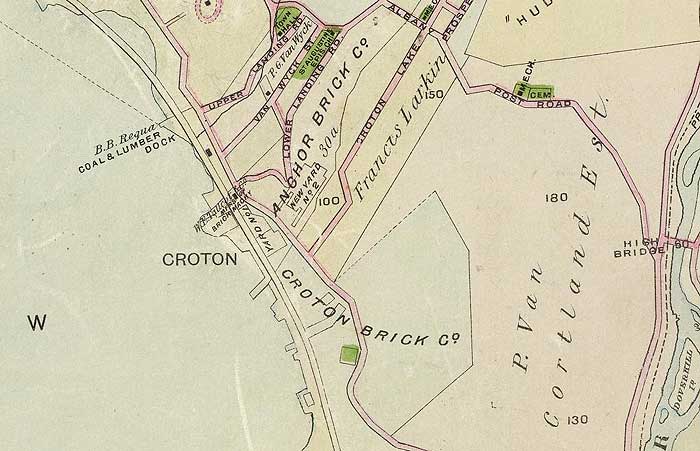
From Brick Manufacturers of the United States by Jim Graves, IBCA: CROTONBARLOW, GEORGE J. 1877COX, JOHN 1840 - 1870 CROTON POINT BRICK CO. 1904 FROST & DOTY 1839 FROST, EUGENE 1905 - 1910 FROST, J. W. 1830 - 1850 (lower yard) (father of Cyrus and Orrin Frost) HULL 1839 MORTON, GEORGE W. 1877 MORTON, JOHN 1898 - 1900 MYERHOFF & BROTHER 1877 SOUTHARD, THOMAS D. 1859 - 1877 WAGER & HULL 1839 WOOD, JESSE 1838 CROTON LANDINGANCHOR BRICK CO. 1888 - 1895ARTHUR, G. D. & CO. 1888 COX & BARLOW 1874 CROTON BRICK CO. 1888 - 1900 FROST, ORRIN 1895 HAMILTON, SCHUYLER 1886 - 1890 MORTON, GEORGE & JOHN 1874 TALLCOTT, RICHARD D. 1874 U.S. BRICK & ENAMELLING CO. 1888 UNDERHILL & COMPANY 1874 UNDERHILL, WILLIAM 1888 - 1900 VAN CORTLANDT, P. 1874 CROTON ON HUDSONCUBA CLAY WORKING CO. 1897KITCHAWAN BRICK CO. 1899 - 1900 SWAIN & CO. 1883
(Thanks to Michael Anzalone for these photos)
From New York state business directory and gazetteer, 1870:
Cocks and Barlow
From History of Westchester County, 1886,
Francis Larkin and Marcus L. Cobb
(George D. Arthur & Co.)
Just to the left of Anchor, right on the Hudson River is "W.E. Tallcott & Co., Mfrs. of Brick Macry." William E. Tallcott had several patents on brick-making machinery. Click the dates to see drawings & descriptions:
From The New York Times, June 10, 1903:
From St. Augustine's Episcopal Church, "Our History:"
New York at the Louisiana Purchase Exposition,St. Louis 1904, by DeLancey M. Ellis"Catalogue of Exhibitors in the Department of Mines and Metallurgy:" "W. B. Underhill Brick Co., Croton Landing"
Excerpt from:
History of Westchester County,Scharf, John Thomas, 1886Volume 2, Chapter V, "Cortlandt," page 419:
ADDITIONAL ARTICLES: Effort Launched to Protect History of Croton Point WOOD v. UNDERHILL, 46 U.S. 1 (1847)
Adam Stone
pre-colonial times -- the Kitchawank Indians, part of the Mohican tribe, lived in the area. 1609 -- Henry Hudson sails up the Hudson River. earliest settlers -- William and Sarah Teller operated a trading post on Croton Point. 1645 -- peace agreements signed beneath what became known as the Treaty Oak. 1677 -- Van Cortland Manor of Stephanus Van Cortlandt. 1682 -- Cornelius Van Bursam purchased the land from the Indians. 1686 -- Stephanus Van Cortlandt acquired all the land between the Croton River and Anthony's Nose. 1697 -- the area was part of a vast land grant from King William III to Stephanus Van Cortlandt; Van Cortlandt had been purchasing blocks from various Indian groups for some time. 1700 -- death of Stephanus Van Cortlandt. Son Philip Van Cortlandt became Second Lord of the Manor. His wife was Catherine de Peyster. After the father's death, the 83,000 acre estate was gradually broken up. The Van Cortlandts started selling their land holdings in Croton Point and in the future Croton Village, Harmon and Mount Airy. 1748 -- death of the Second Lord of the Manor, Philip Van Cortlandt. Son Pierre Van Cortlandt becomes the Third Lord of the Manor. He was married to Joanna, daughter of Gilbert Livingston. Revolutionary War -- Van Cortlandt was visited by Rochambeau, Lafayette, the Duc de Lauzun, von Steuben, Baron de Kalb, Gen Philip Schuyler, and Washington and his aides. Revolutionary War -- British troops commandeered Van Cortlandt Manor and some even carved their initial into the mantel in one of the rooms. Revolutionary War -- the British spy Major John Andre was supposed to have made his escape with the plans of West Point on the British sloop Vulture laying at anchor off Croton Point. But members of the Westchester Militia spotted the ship. The Militia members brought a cannon in from Verplanck's Point and were able to damage the ship which then sailed away before Andre could reach it. Andre had to find a land route and he was subsequently apprehended in Tarrytown. 1788 – Cortlandt became a town with Philip Van Cortlandt its first supervisor. 1804 -- Robert Underhill purchased 250 acres of Croton Point for farming. 1814 -- death of Third Lord of the Manor, Pierre Van Cortlandt. 1829 -- death of Robert Underhill; his sons Dr. Richard and William inherited the land. Richard raised grapes, apples and roses on his 85 acres and William manufactured bricks on his 165 acres. Richard built a mansion called Interwasser near the southern tip of Croton Point. 1835 – New York City voted to construct a 40 mile brick-lined gravity-fed aqueduct from the Croton River into Manhattan. 1837 – construction began on the first Croton Aqueduct and dam. Many of the workers were Irish. 1842 – the dam was completed. 1849 – the railway was built as far as Peekskill; the Croton station was on River Street (later Riverside Avenue). A result was a much more rapid population growth in the area with a town growing around the railway and station. 1855 – work on the new Croton aqueduct began. 1883 – there were 13 brickyards operating between Croton Point and Verplanck making 64,000 bricks a day. 1885 – the need for a new Croton Dam was already being explored. 1890 – the new Croton Aqueduct completed. 1890s – a series of droughts led the New York City Aqueduct Commission to call for a new aqueduct and reservoir. 1891 – the Aqueduct Commission agreed that a new Croton Dam should be built. (It was to be located about three miles below the old dam on the Croton River. It would cover an area of land 20 miles long) 1892 – construction began on the new Dam. 1896 – work began on a new dam on the site of the old Cornell Farm on the Croton River. 1898 – Croton incorporated. c. 1900 -- Judge Decker of Croton headed the Croton Point beach area and organized the Croton Point Club. (There were 23 vacation bungalows along the beach.) 1900 – a labor strike led to some people getting injured. The cavalry was called in for a while before the workers were given a slight wage increase. 1906 – the new Dam was completed, the second-largest hand-hewn structure in the world, after the famous pyramids of Egypt. 1907 – the new masonry Croton Dam completed as well as a new aqueduct. c. 1912 -- Point Pleasant Park was opened at the southern tip of Croton Point. Visitors could picnic on the lawn of the Interwasser mansion. 1915 -- when the clay supply was exhausted, the Underhill brickyard closed. early 20th century – there was an influx of artists into the village. WWI -- journalist and socialist Jack Reed marries Louise Bryant and the couple moves to Croton-on-Hudson and start over. After Reed has a retaliatory affair, Louise soon heads off to France as a journalist on the Western Front. 1920’s – a group of writers and artists from Greenwich Village started buying old farm buildings on Mount Airy Road. Many worked on a monthly magazine named The Masses, a publication that supported views of the political left. 1923 -- opening of the Croton Point Park, an amusement park, on the north shore near the bathhouses. 1923 -- Camps Kitchawanc and Senasqua at Croton Point provided great camping experiences for both boys and girls. 1924 -- the Westchester Park Commission bought 500 acres of Croton Point. They reserved 70 acres for a landfill for garbage. 1927 – a new roundhouse and 100-foot turntable added to the railway complex. More than half of the male population were directly or indirectly employed by the railroad. by the 1930’s – many left-leaning intellectuals could be found on Mount Airy. Some living in the downtown pejoratively referred to the area above them as "Red Hill." 1932 – a Tarzan movie, "Tarzan the Ape Man," starring Johnny Weissmuller and Maureen O'Sullivan was made in Croton. It is said that for one scene Johnny Weissmuller jumped off a big 80-foot cliff. 1948 -- Westchester County's first drive-in movie theatre, the Starlight, opened in Croton on South Riverside Avenue. (Closed 1972.) 1950s – beginning a tradition of going to the "Dickies" and playing dare-devil around the cliffs. 1953 -- restoration of Van Cortlandt Manor by John D. Rockefeller Jr. and his staff of experts from Williamsburg. 1959 -- opening of the Starlight Lanes Bowling Center. (Lasted 20 years.) 1960s – New York State demolished the buildings along Riverside Avenue to make way for Route 9. There still remains a lot of resentment in the village over the loss of a big part of Croton history. 1972 -- some 40 million gallons of toxic waster were running into the Hudson River from the landfill at Croton Point. 2003 – Croton is now a bedroom community of very affluent to middle-class people.
SOURCES CONSULTED:
Croton-on-Hudson Historical Society
|

 Hudson River Brickmaking | Brick History/How Bricks Were Made Links | Contact Form | IBCA | BOOK SHOP Visitors' Comments/Collections/Brix Pix | Our Collection HOME
|