Brick Collecting?
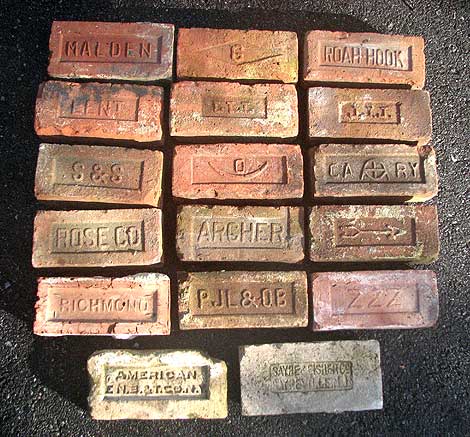
Collecting old branded brick is a growing hobby. Some call it
a crazy hobby, but to find, touch and own a piece of history can be very rewarding...and fun. This web site has several main sections:
-
-
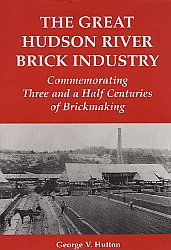
Hudson River Brickmaking:
The extent of the industry in New York and northern New Jersey, now
with an interactive map version
-
Our Collection:
Bricks from the Hudson River Valley and New England with brief notes on
the history of the yards and towns where they were made
-
Links: Other web sites
with fun and interesting information all about brick(s)
-
-
This web site focuses mainly on brick from
the Hudson Valley of New York and New England. A great source for
information on brick around the USA (and around the world) is the International
Brick Collectors Association.
Also, of note is Dan Mosier's fine
web site on California Bricks which has a great page on just
what Collecting Bricks is all about.
Bricks were produced in many areas
around the United States and Canada where craftsmen brought their skills from Europe to places that had the right type of clay suitable
for brickmaking and good access to transportation.
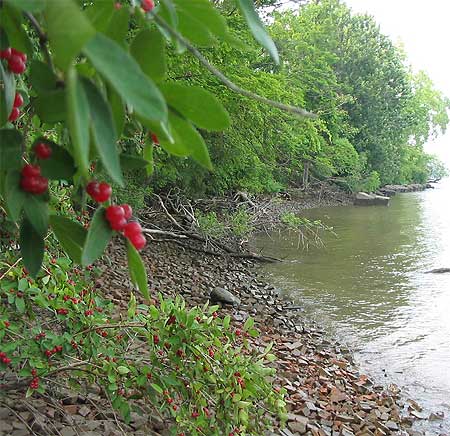
HUTTON bricks along the
Hudson River at Kingston Point Beach, July, 2006
One such area, the Hudson River Valley
in New York State, with its abundance of clay and an excellent water link to New York City, churned out millions of bricks, mostly near the
turn of the 20th century. In Haverstraw, in Rockland County, NY, there is the Haverstraw
Brick Museum. In the 1880s there were over 40 brickyards in the Haverstraw area. Many buildings in New York City are made with bricks
manufactured in Haverstraw. For more information on Hudson River Brickmaking, Click Here.
At one time, the state of Connecticut
had more than 200 brickmaking companies. As a result of past glaciation periods, many clay deposits dot the state and many of these were
exploited to make bricks. The history of brickmaking in the state is explored in a special section of the Connecticut Museum of Mining and Mineral Science.
From the National Building Museum's American
Brick Collection:
|
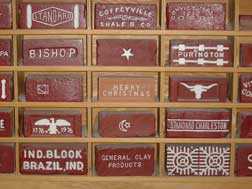
A variety of 19th and 20th century brick
samples from the National Building Museum Collection,
which contains more than 1,800 examples from brickyards around the country
|
Brick is one of the oldest and most enduring man-made building materials.Sun-dried mud brick, or adobe, appeared about 10,000 years ago, and the earliest kiln-fired or clay-baked brick dates to 3,500 BC. This marked the first time humans were able to construct permanent, fireproof structures without stone.
Since at least 1611, when English brickmakers were recruited to Virginia, fired brick has been part of the North American landscape. Indelibly tied to the colonial era, brick came to define the nation’s industrial age and remains linked to contemporary notions of the American factory, school, and single-family house.
Although once manufactured with incredible variety, brick production today is far more limited because the material is no longer used structurally, but rather as veneer.
|
|
A labor of love, the Museum’s extensive American Brick Collection was amassed by Raymond Chase over 24 years. The collection now holds some 1,800 decorative, face, fire, paving, pressed, and common bricks from around the nation. And unlike the country’s anonymous army of bricklayers, many of these late-19th and early 20th-century brick are branded with the name or location of their originating brickyard, or a distinguishing mark.
|
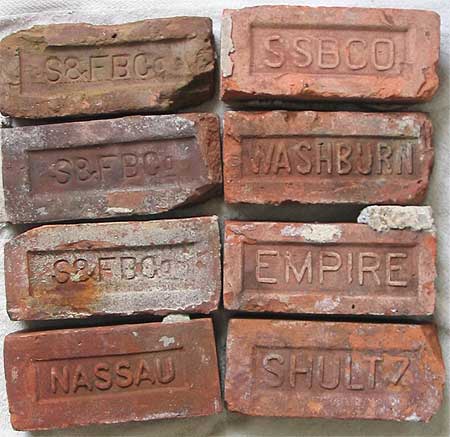
We often get asked where old bricks can be found. The best places are former brickyards, construction sites, abandoned building sites, demolition sites, dump sites, land-fill and beaches.
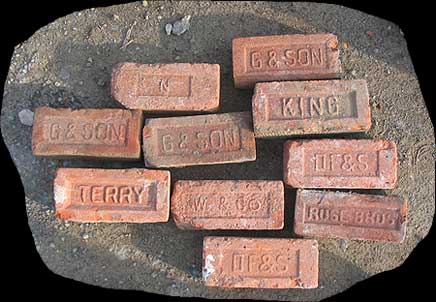
Just a few of the many bricks found by website visitor Jason in the Bronx, NY
Webmaster Note: We'd like to thank Jason for donating the bricks pictured above as well as the following. Note the range of towns up and down the Hudson and even in Connecticut where these bricks were made. Jason found them all in ruins of buildings in the Bronx.
M&LW Mordecai & Lucien Washburn Haverstraw (Grassy Point)
RMBCo Richard Murray Brick Co., Berlin, CT
J.C.M. John C. Maginnis, Glasco
L & O BB John Lynch, John & Mark OBrien Bros., George's Island
J.J.J. Juan Jacinto Jova, Newburgh
KLINE Jacob Kline, Port Ewen
DFJr&Co Denton Fowler Jr. & Co, Haverstraw
G&G Gladfelter & Gladfelter, Athens
TERRY BROS. Terry Brick Co.(David,Albert & Edwin), Kingston
MBC Mayone Brick Co., Athens
TBCo Troy Brick Co., Troy
W&F Uriah Washburn & Denton Fowler, Haverstraw
MALDEN Malden Brick Co., Malden
CBCo Champlain Brick Co., Mechanicville
MBW Malden Brick Works, Malden
AMERICAN American Brick Co., Berlin CT
TUTTLE Tuttle Brick Co., Middletown, CT
XXX George W. Washburn, Catskill
STAPLES Terry Staples, Malden
Bricks found at demolition site,
Pilgrim Psychiatric Center,
998 Crooked Hill Road, West Brentwood, NY, September, 2007
(Thanks to Bill from St. James, NY for tipping us off on this location!)
Bricks found in land-fill (site now closed), Milton, NY, January, 2007
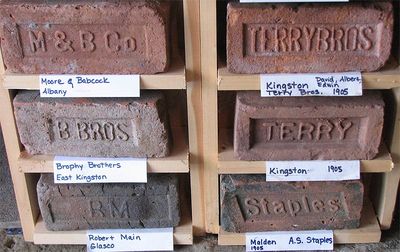
Some collectors build custom shelves to display their brick
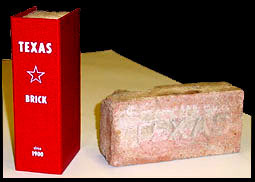
Others even have their bricks bound
Over the years, we've added some new specialized pages and sections:
- Brick
Clicks
- Brick Flick
- BRIGHAM
Bros.
- Cape
Cod Brickmaking
- Catskill,
NY
- Coeymans,
NY
- Croton,
NY
- Danskammer
Point
- DPBW:
Dennings Point Brick Works
- Dutchess
Junction
- East
Kingston
- "E-Zine"
Articles
- Glasco
- Haverstraw
- Histories
of Brick Companies Still in Existence
- HUTTON
Brick Company
- JOVA,
JJJ
- Kingston,
NY (incl. East Kingston & Whiskey Point)
- MAYONE ("The Gentleman
from Ulster," a history of the MAYONE Brick Co. in Athens and Glasco,
NY)
- NEBCo:
New England Brick Company
- ROSE,
Roseton, NY
- Rosendale Cement
- SHULTZ
Brick Company
- Ulster
Landing, NY
- Verplanck,
NY (incl. Montrose and Crugers)
- W.A.U:
Tales from Croton Point (The story of the William A.
Underhill Brickyard)
- West
Barnstable Brick Company, Cape Cod, MA
I hope you enjoy this
web site.
--Don Bayley
|